
Inside the Stoop 360 Fleet: DJI Avata 360 and DJI Mini 5 Pro
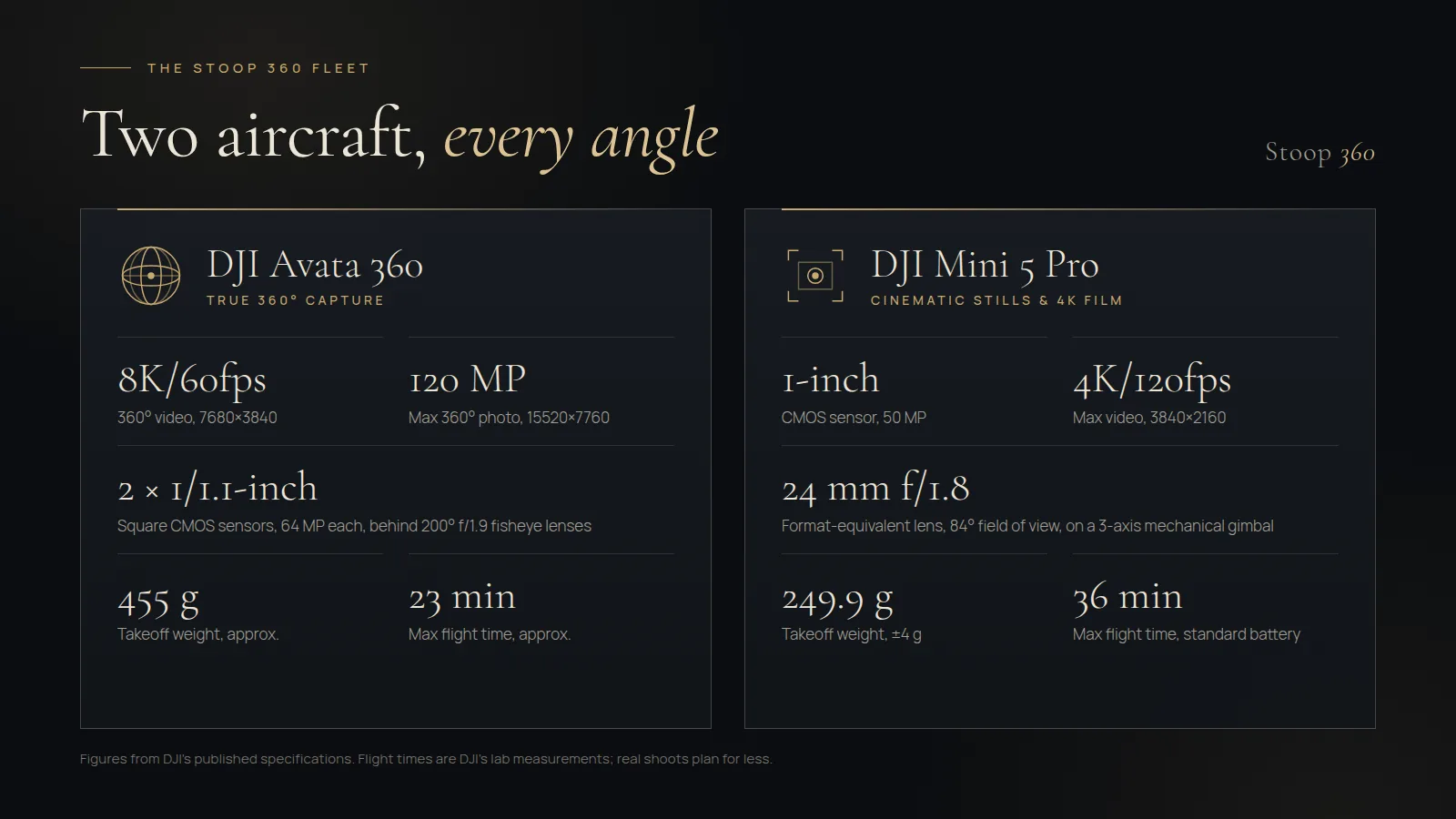
Every Stoop 360 shoot starts with one question: does this project need one perfect frame, or every frame at once? The answer decides which drone comes out of the case. Our fleet is two aircraft, the DJI Avata 360 and the DJI Mini 5 Pro.
Here is how we use each, what DJI's own specifications say, and why we chose them. Where DJI doesn't publish a number, we leave it out.
DJI Avata 360: the whole sphere in one flight
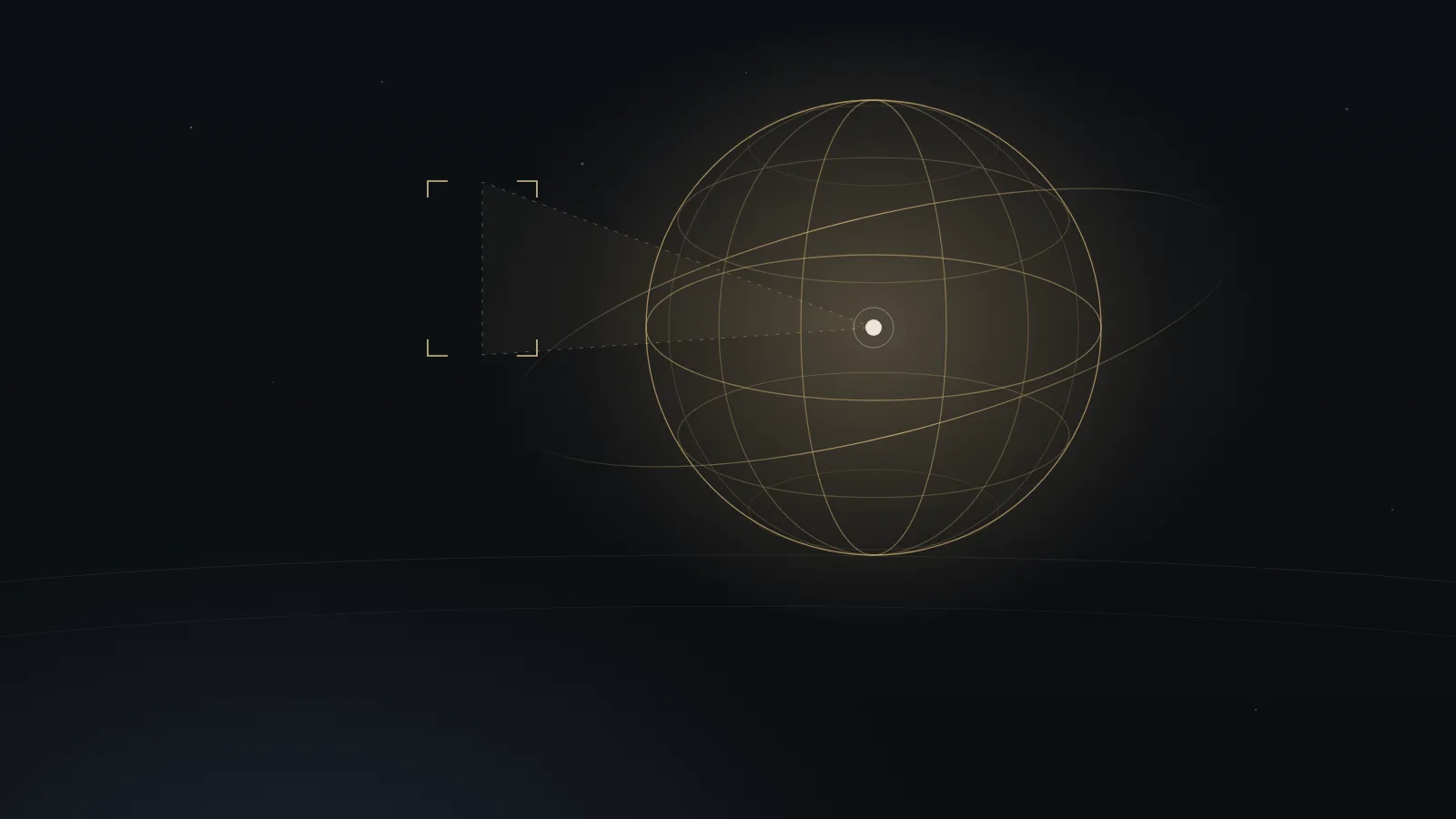
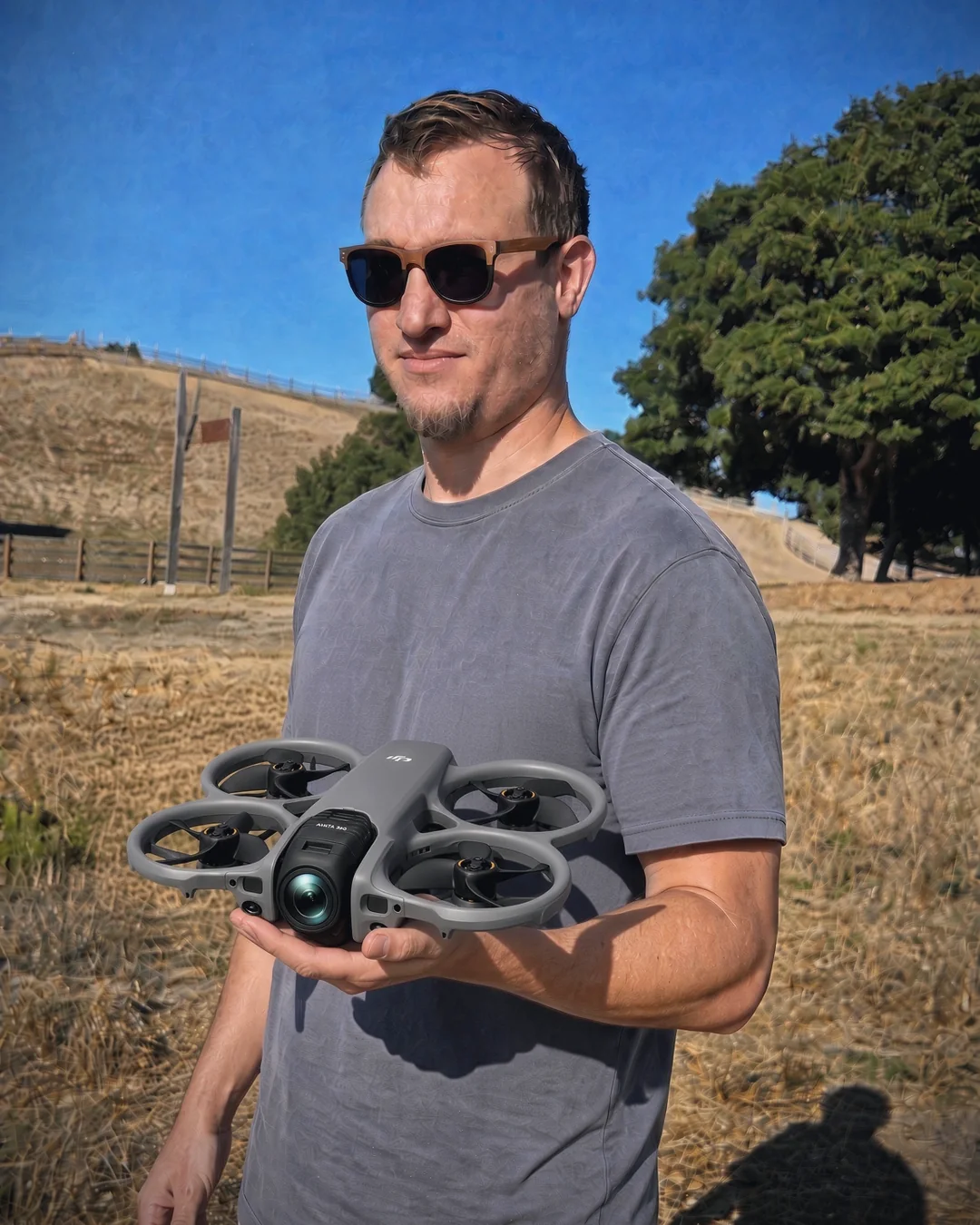
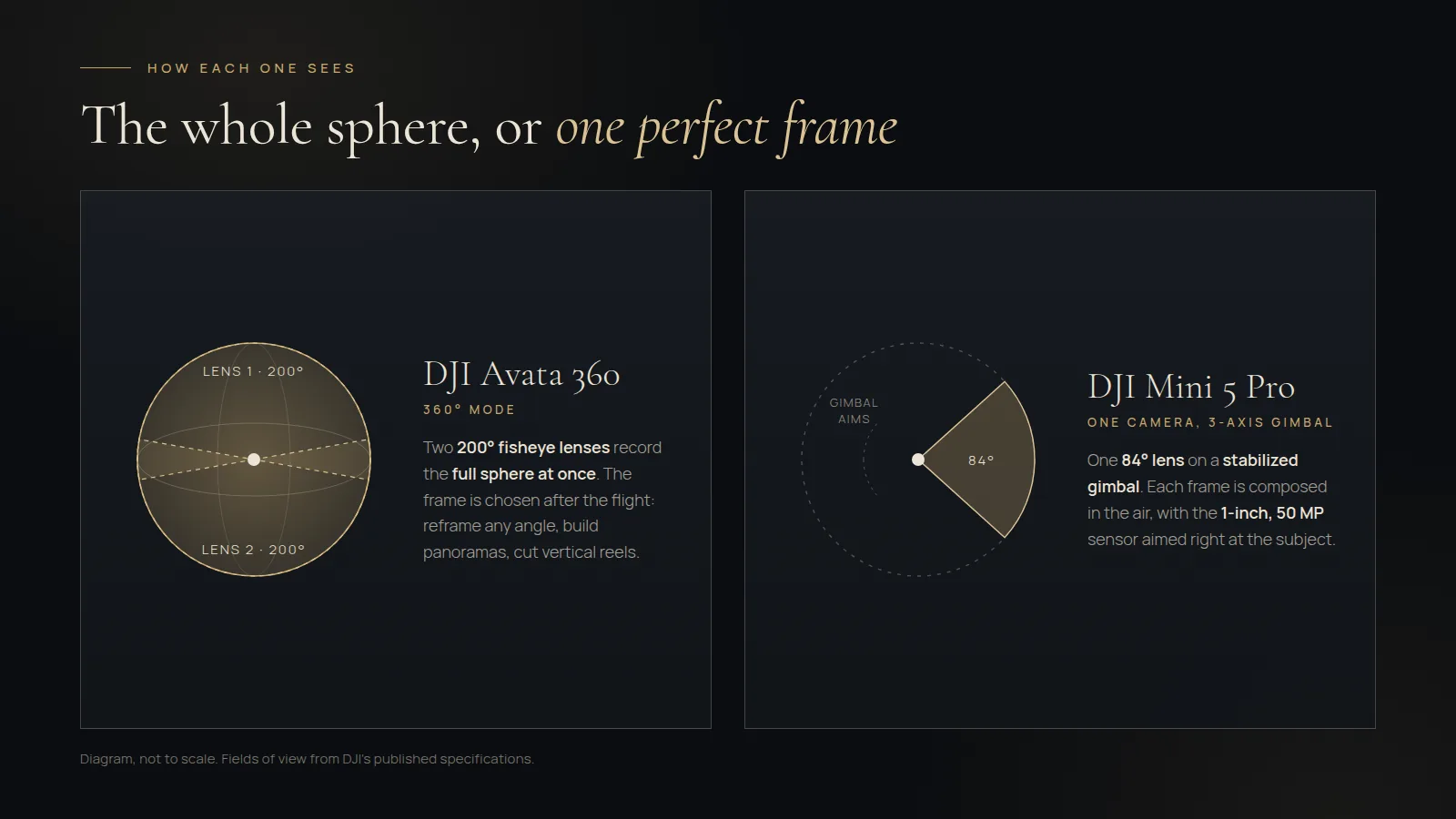
The Avata 360 is the drone behind the "360" in our name. In 360-degree mode, two opposing fisheye lenses, each covering 200 degrees, record the full sphere around the aircraft at once. DJI says the aircraft disappears from the footage, leaving an open view in every direction.
How we use it
- Immersive panoramas and tours. One capture gives viewers a full sphere to drag, swipe or explore by turning their phone. See what a 360 drone tour shows.
- Reframing any angle in post. Nothing outside the frame is lost, so we choose the camera angle in editing. One pass over an estate can become a reveal, a top-down shot and a slow orbit.
- Vertical reels from 360 footage. The same capture can be cut to 9:16 for Instagram, TikTok or YouTube Shorts without a second flight.
- FPV-style fly-throughs. DJI built the Avata 360 for first-person-view flight, with an integrated propeller guard, and its Single Lens mode records 4K with an FPV look for one-take fly-throughs. Flying through goggles, Part 107 requires a visual observer to keep the drone in sight.
DJI Avata 360 specifications
| Specification | DJI Avata 360 |
|---|---|
| Takeoff weight | Approx. 455 g (about 1 lb) |
| Image sensors | Two 1/1.1-inch square CMOS sensors, 64 MP effective each |
| Lenses | 200° field of view, f/1.9 |
| 360° video | 8K (7680×3840) and 6K (6000×3000), up to 60fps |
| 360° photo | Up to 120 MP, JPEG and DNG RAW |
| Single Lens mode | 4K video up to 60fps |
| Gimbal | Single-axis mechanical (tilt) plus a 360° virtual gimbal |
| Obstacle sensing | Omnidirectional vision (360° mode only) plus forward-facing LiDAR |
| Max flight time | Approx. 23 min, lab-measured |
| Max wind speed resistance | 10.7 m/s (about 24 mph), Level 5 |
DJI Mini 5 Pro: one perfect frame, in 4K
When a project calls for a polished, conventional image, we fly the Mini 5 Pro: a single 1-inch, 50 MP camera on a three-axis mechanical gimbal, with every frame composed in the air.
How we use it
- Listing photos. High-resolution stills of the home, lot and neighborhood for real estate aerial photography, with exposure bracketing and RAW files for careful editing.
- Wedding and event films. Smooth 4K of the venue and the grounds, with 4K at 120fps for slow motion. 10-bit HLG and D-Log M give more latitude when grading to match the ground crew's footage.
- Twilight. A bright f/1.8 lens on a 1-inch sensor helps as the light fades, when pools, landscape lighting and skylines come alive. Part 107 requires anti-collision lighting visible for three statute miles during civil twilight, so it's part of the plan.
- True vertical shots. DJI rates the gimbal for 225 degrees of roll rotation, so the camera can shoot portrait frames instead of cropping a landscape one.
DJI Mini 5 Pro specifications
| Specification | DJI Mini 5 Pro |
|---|---|
| Takeoff weight | 249.9 g (±4 g) with the standard battery |
| Image sensor | 1-inch CMOS, 50 MP effective |
| Lens | 84° field of view, 24 mm equivalent, f/1.8 |
| Photo | 50 MP or 12 MP, JPEG and DNG RAW |
| Video | 4K up to 60fps, 4K/120fps slow motion |
| Gimbal | Three-axis mechanical (tilt, roll, pan) |
| Obstacle sensing | Omnidirectional vision plus forward-facing LiDAR |
| Max flight time | 36 min (standard battery), 52 min (Battery Plus), lab-measured |
| Max wind speed resistance | 12 m/s (about 27 mph) |
Why these two drones
360 capture and a standard gimbal camera do different jobs
A gimbal drone points one camera one way at a time, ideal for a planned shot. A 360 drone records every direction at once, so framing moves to the edit and moving water or trees don't break a panorama shot in sequence. Flying both means neither tool does the other's job.
Large sensors for detail and low light
The Mini 5 Pro has a 1-inch sensor, and DJI cites up to 14 stops of dynamic range for its video in Auto mode. The Avata 360's square 1/1.1-inch sensors each give an imaging area equivalent to a 1-inch sensor in 360-degree mode, with 2.4 μm pixels and up to 13.5 stops of dynamic range, according to DJI. That means cleaner skies and more shadow detail at golden hour and twilight.
Weight class: helpful, but not a loophole
DJI lists the Mini 5 Pro at 249.9 grams with the standard battery, give or take 4 grams between batches, and heavier with the Battery Plus. A light aircraft is easy to bring onto a site and carries less energy in flight. What weight does not change is the law for commercial work: the FAA's under-250-gram registration exception covers recreational flying only. Flown for business, both drones fall under FAA Part 107, with a certified remote pilot, an FAA registration for each drone and Remote ID compliance. Weight alone doesn't permit flights over people, either.
Safety features that back up good planning
Both drones pair omnidirectional vision sensing with forward-facing LiDAR. DJI says the Mini 5 Pro's LiDAR still senses obstacles ahead when it's too dark for the cameras, and that the Avata 360's full sensing works only in 360-degree mode; the Avata 360 adds an integrated propeller guard. These are a safety net, not a plan: every flight starts with an airspace check, a site walk and a route clear of bystanders.
Flight time
DJI rates the Mini 5 Pro at up to 36 minutes and the Avata 360 at about 23. Those are lab figures, so we plan margins and swap batteries before the light changes.
Choosing the right drone for your shoot
You don't need to pick the aircraft; tell us what you want to show. As a rough guide, listing stills, twilight and wedding or event films call for the Mini 5 Pro; tours, reframable footage, vertical reels and fly-throughs call for the Avata 360; estates and venues often get both in one visit.
We fly across Dallas, Fort Worth, Frisco and Plano, Austin and Round Rock and Georgetown. Explore our services, or request a shoot and Landon will plan the flight.
Specifications are from the official DJI Avata 360 and DJI Mini 5 Pro spec, FAQ and product pages on dji.com (UK and global editions), as published in October 2026. DJI may update them. Regulatory notes are general information, not legal advice; see the FAA's pages on drone registration and Remote ID.
Frequently Asked Questions
Which drones does Stoop 360 fly?
The DJI Avata 360 for true 360-degree capture, panoramas and FPV-style fly-throughs, and the DJI Mini 5 Pro for 4K video and high-resolution stills, from listing photos to wedding films and twilight frames.
Does a drone under 250 grams need a licensed pilot for commercial work?
Yes. Any business use falls under FAA Part 107, whatever the weight: the pilot needs a remote pilot certificate, and the drone must be registered and comply with Remote ID. The under-250-gram registration exception applies only to recreational flying.
Can these drones fly at twilight?
Yes, under Part 107, when the pilot has completed the required training and the drone has anti-collision lighting visible for at least three statute miles. Stoop 360 plans twilight flights to meet those requirements.
Images in this article are illustrative and do not depict specific Stoop 360 projects.
Keep reading

What a 360 Drone Tour Shows That Ordinary Photos Can't
One position in the sky, every direction at once. A plain-English look at immersive aerial panoramas and where they make a real difference.
Read article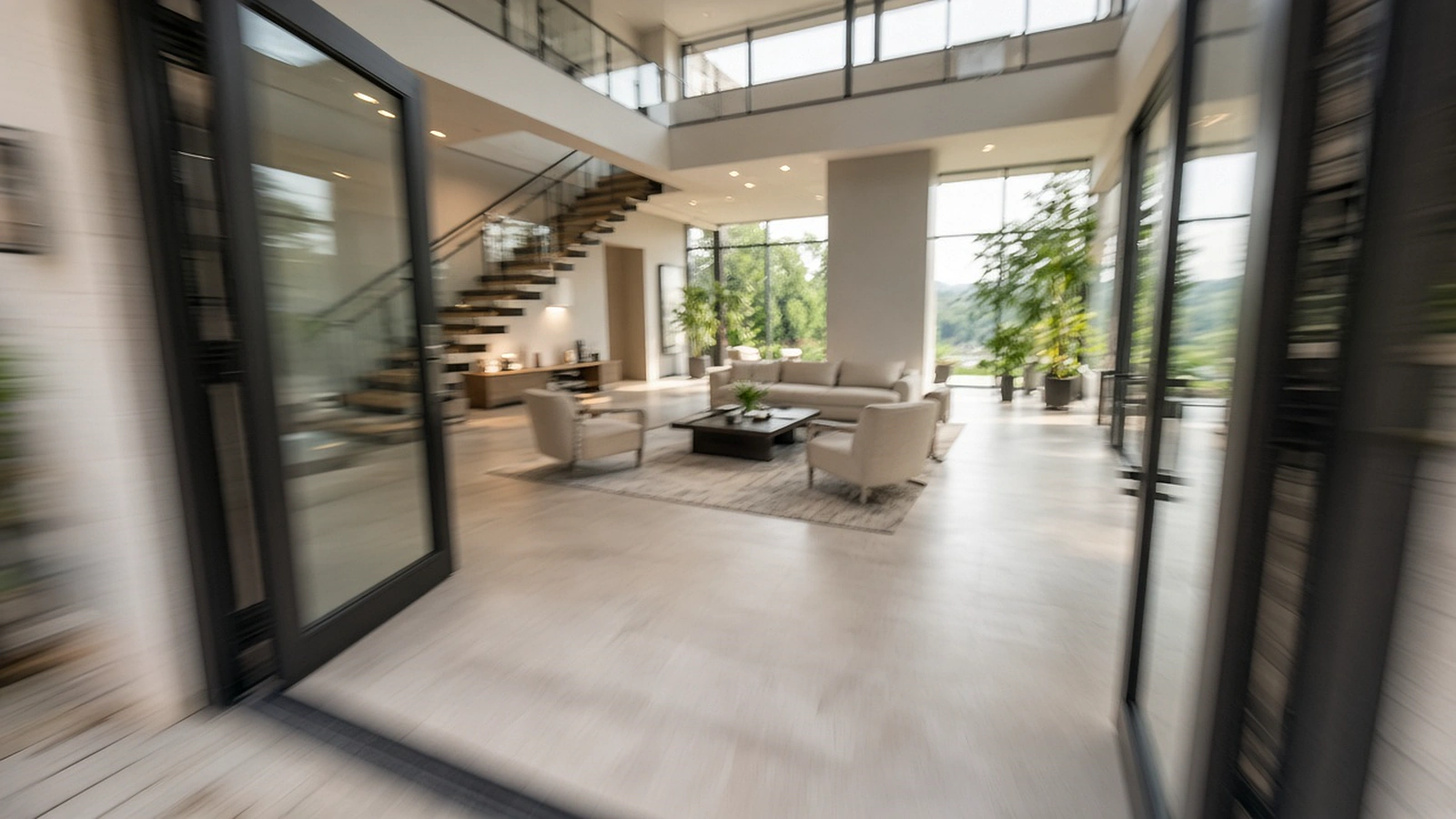
FPV Fly-Through Videos: The One-Take Tour Everyone Is Talking About
Through the front door, down the hall, out over the pool and up into the sky, in one continuous shot. How FPV fly-throughs are planned and when they're worth it.
Read article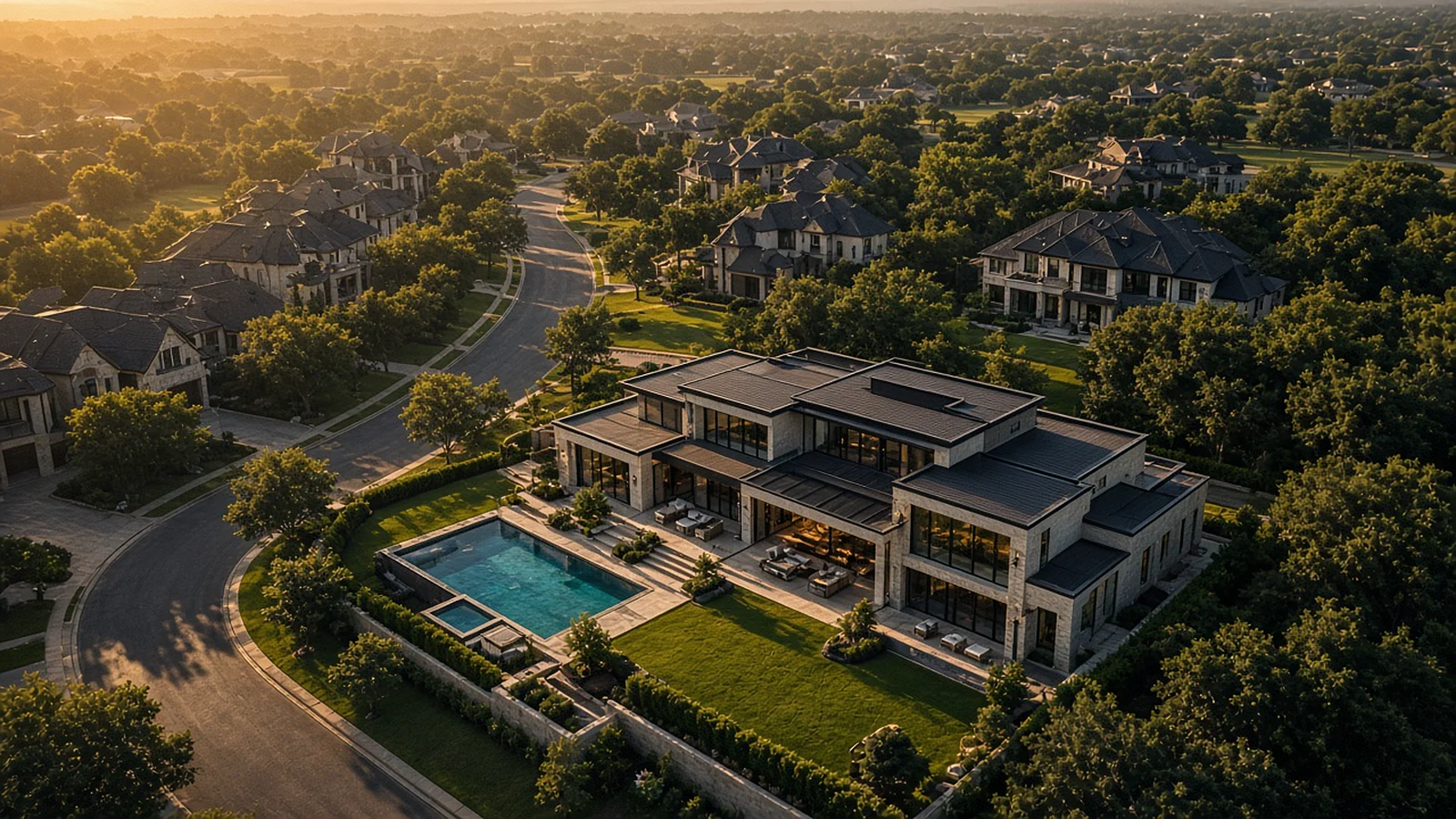
Drone Real Estate Photography in DFW and Austin: How Aerial Images Help a Listing Stand Out
Lot lines, views, the pool, the drive to the lake. Here is how aerial photos tell the part of a listing that ground photos can't.
Read article